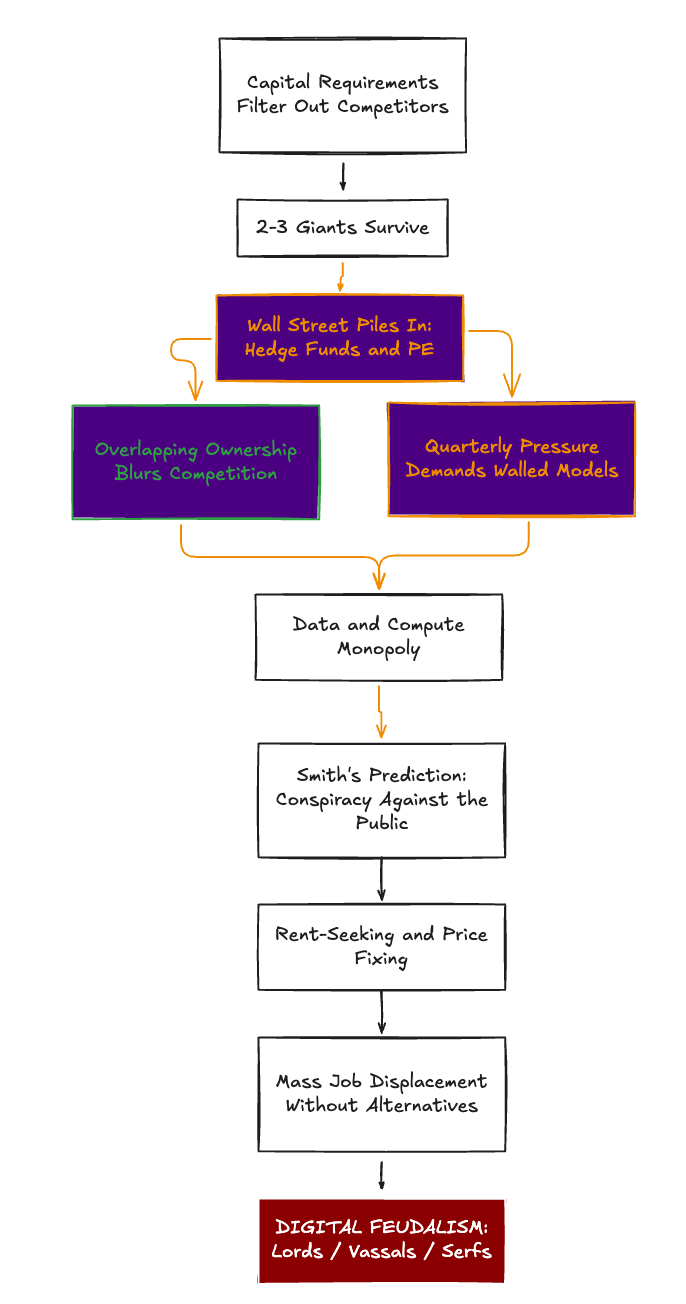
Adam Smith told us that competition, left alone, would guide society toward abundance. Friedman doubled down: let businesses chase profit, and the invisible hand will sort the rest. For decades, this mostly worked. Competition pushed prices down, quality up, and even the poorest lived better than kings of old. Then came artificial intelligence. In my opinion, AI is not just another technology. It is a force that could make human labor optional. In theory, that is paradise. Machines do the work. People pursue happiness, the cost of living falls toward zero. Businesses enjoy the so called “productivity without the tax of human labor”.
But theory and reality are not the same thing. We remember Smith as the champion of free markets, he also understood a simple truth: competition is good for the public, but terrible for the businessman. The businessman wants a monopoly.
In The Wealth of Nations, he said:
“People of the same trade seldom meet together, even for merriment and diversion, but the conversation ends in a conspiracy against the public, or in some contrivance to raise prices.”
In 2026,conspiracy is baked into the system of economy itself. Training a frontier model costs billions,the compute, the data, the energy: only a handful of companies on Earth can afford to play. The barrier to entry is not a locked door but an whole ocean to swim cross.
As much as I want to an optimists and frame this as a choice. One road leads to dystopia, the other to a democratic AI paradise. Pick the right path, and we are fine. In reality,there is no fork. Unregulated markets in capital-intensive industries do not branch. They consolidate. Always. The natural gravity of the system pulls everything toward a single point.
Left alone, the invisible hand will hand the keys of the future to two or three silicon valley companies, which will become the lords of the AI economy.
The Lords own the intelligence. They control the models, the compute, the data pipelines.
The Vassals, startups and other enterprises alike, pay rent to access that intelligence. They build on platforms they do not control, subject to terms they did not write.
The Serfs, the general public, lose their jobs to AI and their leverage to monopoly. They consume what the lords permit, at the price the lords set.
This is not a conspiracy theory, but is what keeps me up at night and makes me worry about the future of humanity. It is Smith’s own prediction, applied to silicon instead of steel.
The Referee
Friedman said the business of business is profit. Fair enough. But he also acknowledged that a free market must remain free. You cannot have a free market when three companies own the marketplace. Smith said we cannot stop businesses from colluding, but the law “ought to do nothing to facilitate such assemblies; much less to render them necessary.” Right now, our lack of regulation does exactly that: it facilitates the assembly of power into fewer and fewer hands.
The solution in my two cents, is not to kill the market, but to make it fair. Governments must step in, not as a player, but as the entity that keeps the game fair. That means antitrust enforcement with teeth. It means public investment in open-source AI infrastructure.
The AI revolution offers something no technology has offered before: a world where machines handle the mundane task and humans are free. That is Smith’s ultimate vision, a society so efficient that poverty becomes a relic. But efficiency hoarded is not efficiency shared. The invisible hand cannot work when it is cuffed by monopoly. Unless someone picks up the whistle, the conversation between the new AI lords will end exactly as Smith predicted: in a conspiracy against the rest of us. The question is not whether AI will reshape civilization. It will. The question is whether we let the reshaping happen to us, or whether we shape it ourselves.